

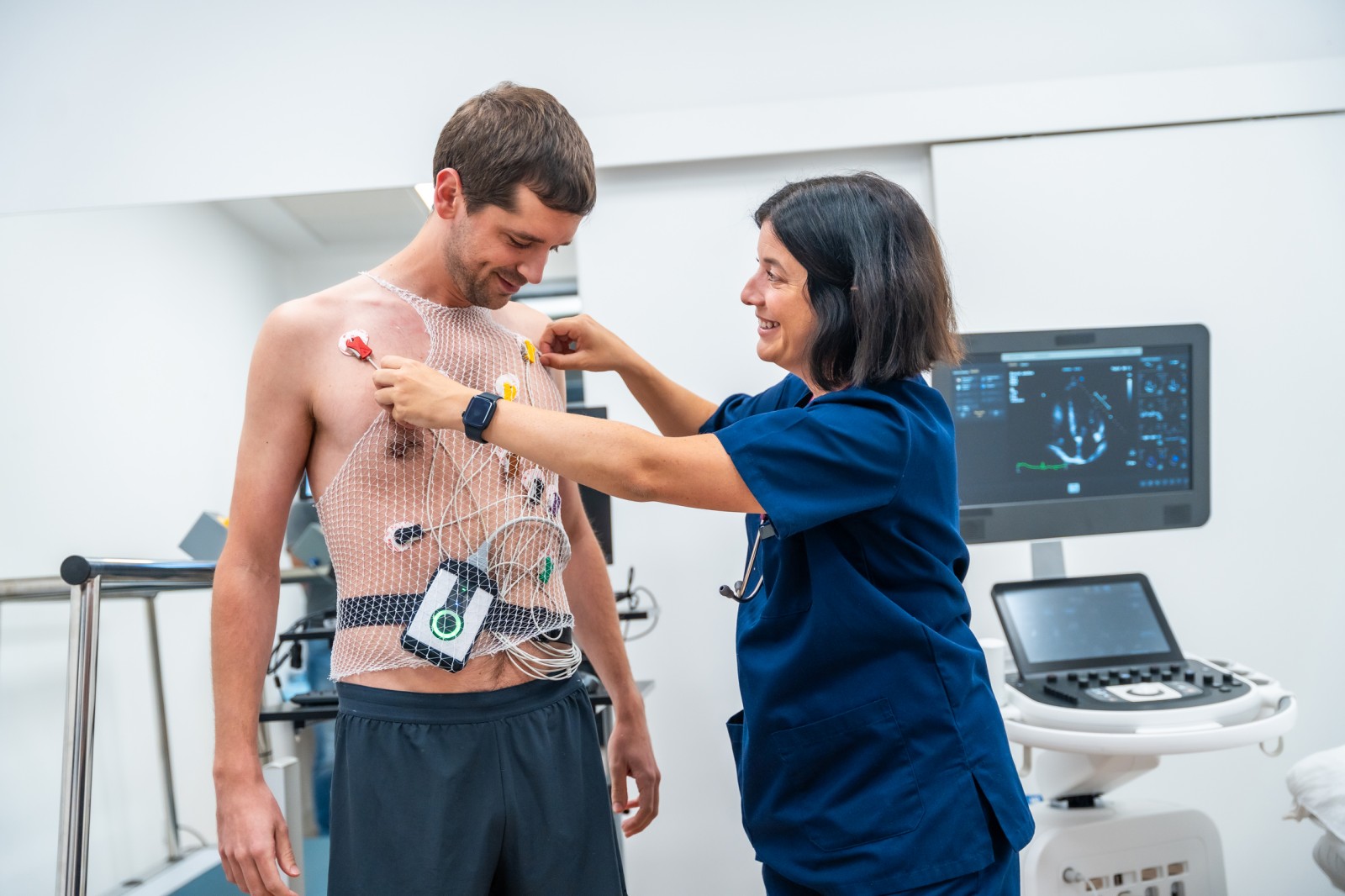
Holter Monitoring
Holter Monitoring Services
Holter monitoring records the patient’s ECG continuously for a defined short period, commonly 24 to 48 hours. It is often selected when symptoms occur frequently enough that a short recording window may capture the relevant rhythm. Specialized Medical supports the practice from enrollment and hookup through recording, data review, final report generation, and physician review.
What Is Holter Monitoring?
A Holter monitor is a wearable ambulatory ECG recorder used during normal daily activity. Specialized Medical maintains LIVE test-status visibility throughout the study, including battery level, electrode contact / signal quality, device communication, and whether the patient appears connected. If a parameter falls outside the expected range, Specialized Medical contacts the patient and works with the patient to correct the issue. Unlike MCT and Event Monitoring, Holter clinical findings are presented after the final report is generated rather than while the study is in progress.
Two points to remember
(1) LIVE test-status visibility is maintained while the Holter study is in progress, and (2) clinical results are presented after the final report is generated.
When a Holter Study May Be Ordered
Non-prescriptive examples include frequent palpitations, dizziness, suspected ectopy, rhythm correlation with symptoms, rate assessment, or follow-up when a short recording period is clinically appropriate. The ordering provider determines the appropriate modality and duration — patients should not choose the test themselves.
A Holter may be less likely to capture infrequent symptoms. In those cases, the physician may consider a longer monitoring option such as Long-Term Holter Monitoring.
What the Patient Should Expect
- EnrollmentConfirmed in the office, or pre-enrolled in advance
- Skin preparationSite prepared for reliable electrode contact
- Device placementPatch or lead-wire configuration applied per instructions
- RecordingNormal activity with symptom documentation and bathing restrictions
- Return / disconnectDevice returned or disconnected in the office
Separate instructions apply for patch and lead-wire configurations where necessary. Patients should not attach the monitor incorrectly, should not power off the connected equipment unless instructed, and should contact support if the monitor becomes detached or the device indicates a problem.


Emergency symptoms
Patients with chest pain, severe shortness of breath, fainting, stroke symptoms, or other urgent symptoms should follow their physician’s instructions and seek emergency assistance — call 911 — rather than waiting for a monitoring call.
Holter Analysis and Final Reporting
The ECG recording is processed after the study is complete. The final report may include rhythm overview, heart-rate information, ectopy, pauses, arrhythmia episodes, symptom correlation, representative strips, and other measurements supported by the study and reporting configuration.
No specific finding or diagnosis is promised. The physician reviews the report in the context of the patient’s history, symptoms, examination, and other testing.

Holter Versus Extended Holter and MCT
Specialized Medical LIVE STREAMING configurations provide LIVE test-status visibility while the study is in progress. Specialized Medical can see operational information such as battery level, electrode contact and signal quality, whether the monitor is communicating, and whether the patient appears to remain properly connected. When a parameter falls outside the expected range, Specialized Medical contacts the patient and works with the patient to correct the issue so the study has the best opportunity to be completed successfully. For Holter and Extended / Long-Term Holter LIVE STREAMING studies, clinical results are presented after the final report is generated. For Event Monitoring and Mobile Cardiac Telemetry (MCT), qualifying clinical findings are presented while the test is in progress according to the prescribed notification protocol. Traditional NOT LIVE STREAMING Holter configurations do not provide LIVE test-status visibility during the study.
| Monitoring Type | Typical Duration | LIVE Test-Status Visibility | Clinical Findings Presented |
|---|---|---|---|
| Holter Monitoring (LIVE STREAMING) | 24–48 hours | Yes | After Final Report Is Generated |
| Extended / Long-Term Holter (LIVE STREAMING) | 3–14 days | Yes | After Final Report Is Generated |
| Cardiac Event Monitoring (LIVE STREAMING) | Up to 30 days | Yes | During Test — According to Prescribed Notification Protocol |
| Mobile Cardiac Telemetry (MCT) (LIVE STREAMING) | Up to 30 days | Yes | During Test — According to Prescribed Notification Protocol |
| Holter Monitoring (NOT LIVE STREAMING VERSION) | 24–48 hours | NO | After Final Report Is Generated |
| Extended Holter (NOT LIVE STREAMING VERSION) | 3–7 days | NO | After Final Report Is Generated |
Holter is generally best suited to a short period when symptoms are frequent. For a full-program view, see Cardiac Monitoring Services.
Extended Holter provides a longer recording window. Read more about Long-Term Holter Monitoring.
Event Monitoring and MCT can present qualifying findings during the study according to protocol. Read more about Cardiac Event Monitoring and Mobile Cardiac Telemetry (MCT).
Frequently Asked Questions
The prescribed period is commonly 24 to 48 hours, but the ordering physician determines the exact duration.
Yes, Specialized Medical has LIVE operational visibility during the Holter study, including battery status, electrode contact / signal quality, device communication, and whether the patient appears connected. However, Holter clinical results are presented after the final report is generated.
A Holter study is designed to record continuous ECG data during the prescribed period, subject to signal quality, electrode contact, device operation, and patient adherence.
Patients should follow the activity instructions provided by the ordering practice and Specialized Medical.
Follow the device-specific bathing instructions. Some components must be removed or protected before bathing.
Follow the replacement instructions provided with the study or contact the support number supplied by the practice.
Report timing depends on data availability, study completion, and the service workflow. Practice-specific expected turnaround is confirmed with the practice before it is published.
The ordering physician or other qualified treating provider is responsible for clinical interpretation and treatment decisions.
The physician may determine that a longer monitoring period or a different test is appropriate.
The recording itself is noninvasive, although some patients may experience temporary skin irritation from adhesive electrodes.
Request Holter Monitoring Information
Specialized Medical can review the practice’s current ambulatory cardiac monitoring workflow, explain the available service options, and demonstrate how enrollment, monitoring, reporting, and physician review can be configured.
Prefer to talk? Speak With a Cardiac Monitoring Specialist — 1-855-SPEC-MED (1-855-773-2633)
Specialized Medical provides diagnostic ambulatory monitoring. The system is not a replacement for emergency medical services. Patients with urgent symptoms should call 911 or follow emergency instructions rather than waiting for a monitoring call.
Related Cardiac Monitoring Resources
Diagnostic Service Disclaimer: Specialized Medical provides ambulatory cardiac monitoring services and diagnostic information for review by qualified healthcare providers. The service does not replace physician judgment, emergency medical services, or instructions to call 911 when urgent symptoms occur.