

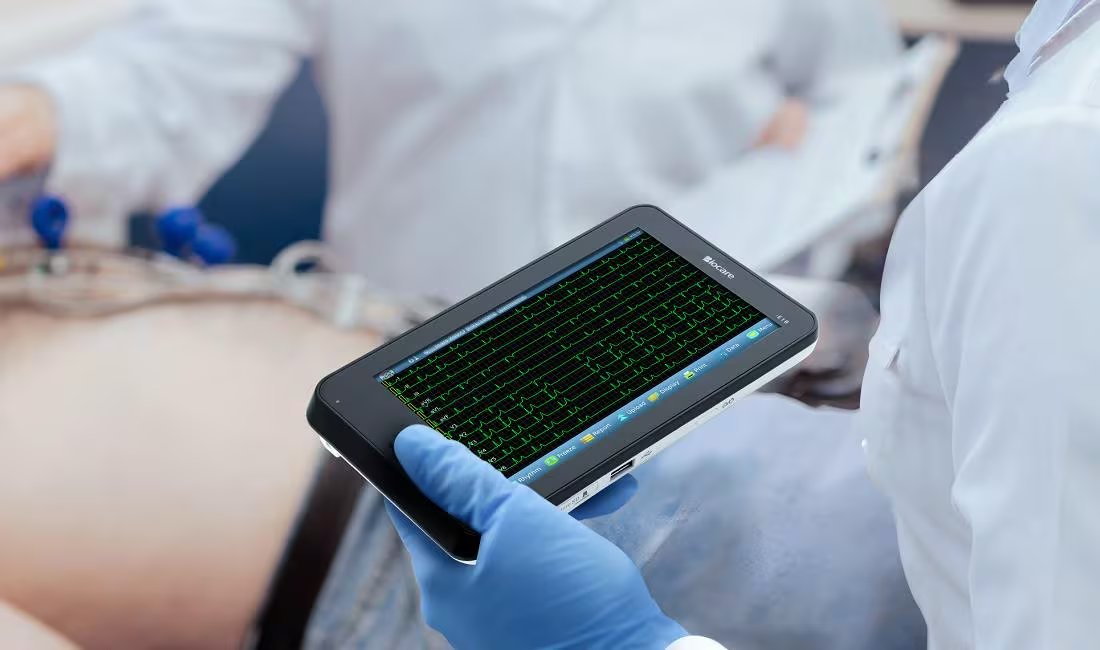
Live ECG Monitoring
Live ECG Monitoring
Live ECG monitoring allows rhythm data to be transmitted from a wearable monitor during the prescribed ambulatory study. In the Specialized Medical workflow, the wearable communicates with a connected smartphone, and the phone transmits ECG information to the monitoring platform when connectivity is available. This makes it possible to review qualifying events and communicate according to the physician’s notification protocol before the final study is complete.
What “Live” Means in Ambulatory ECG Monitoring
Live means ECG information is transmitted during the study rather than waiting for the device to be returned. It does not mean that every beat is watched continuously by a dedicated technician or that communication is instantaneous under all conditions.
Transmission depends on monitor operation, Bluetooth connection, phone status, network availability, and successful data receipt.
From Patient to Monitoring Platform
- ECG acquiredWearable monitor records the rhythm
- BluetoothMonitor connects to the provided smartphone
- Network transmissionPhone transmits through available network
- Monitoring workflowData enters the monitoring platform
- Protocol communicationQualifying findings communicated according to protocol
Reconnection after interruption
The system is designed to reconnect automatically after temporary interruption. This is not an absolute guarantee that no data or transmission delay can ever occur.
Clinical and Operational Benefits
Live transmission may help provide earlier visibility into rhythm information, remote oversight during the study, documented physician notification pathways, patient support, and organized final reporting.
- Fewer disconnected systems across test types
- Clearer notification protocols
- Accessible reports
- Physician electronic signature
Live Monitoring Is Not Emergency Response
Live monitoring is not emergency response
Specialized Medical provides diagnostic ambulatory monitoring. The system is not a replacement for emergency medical services. Patients with urgent symptoms should call 911 or follow emergency instructions rather than waiting for a monitoring call.
Live ECG Versus Post-Study Review
Every modality has LIVE operational visibility during the test. MCT and Event Monitoring present qualifying clinical findings during the test according to protocol, while Holter and Long-Term Holter clinical results are presented after the final report is generated. Each modality has an appropriate role — the ordering physician selects based on the clinical question.
Specialized Medical LIVE STREAMING configurations provide LIVE test-status visibility while the study is in progress. Specialized Medical can see operational information such as battery level, electrode contact and signal quality, whether the monitor is communicating, and whether the patient appears to remain properly connected. When a parameter falls outside the expected range, Specialized Medical contacts the patient and works with the patient to correct the issue so the study has the best opportunity to be completed successfully. For Holter and Extended / Long-Term Holter LIVE STREAMING studies, clinical results are presented after the final report is generated. For Event Monitoring and Mobile Cardiac Telemetry (MCT), qualifying clinical findings are presented while the test is in progress according to the prescribed notification protocol. Traditional NOT LIVE STREAMING Holter configurations do not provide LIVE test-status visibility during the study.
| Monitoring Type | Typical Duration | LIVE Test-Status Visibility | Clinical Findings Presented |
|---|---|---|---|
| Holter Monitoring (LIVE STREAMING) | 24–48 hours | Yes | After Final Report Is Generated |
| Extended / Long-Term Holter (LIVE STREAMING) | 3–14 days | Yes | After Final Report Is Generated |
| Cardiac Event Monitoring (LIVE STREAMING) | Up to 30 days | Yes | During Test — According to Prescribed Notification Protocol |
| Mobile Cardiac Telemetry (MCT) (LIVE STREAMING) | Up to 30 days | Yes | During Test — According to Prescribed Notification Protocol |
| Holter Monitoring (NOT LIVE STREAMING VERSION) | 24–48 hours | NO | After Final Report Is Generated |
| Extended Holter (NOT LIVE STREAMING VERSION) | 3–7 days | NO | After Final Report Is Generated |
Frequently Asked Questions
It is ambulatory ECG monitoring in which rhythm information is transmitted during the prescribed study rather than waiting until the recording is complete.
MCT is a principal form of live ambulatory ECG monitoring. Exact features depend on the prescribed service and configuration.
The service processes and reviews ECG information within the monitoring workflow. It should not be described as one person manually watching every beat continuously.
Communication timing depends on successful transmission, review, the prescribed criteria, and the practice’s notification protocol.
Transmission may be delayed until connectivity returns. The system is designed to reconnect when possible.
Yes. In this workflow the phone is the data gateway and should remain powered, charged, and near the patient.
No such guarantee is made. It is a diagnostic service that may provide earlier visibility into qualifying rhythm events.
Patients with urgent symptoms should call 911 or follow their physician’s emergency instructions.
The report summarizes the study and provides representative ECG information for physician review and interpretation.
A physician may prescribe it after discharge when ambulatory rhythm surveillance is appropriate, including selected delayed heart-block surveillance after TAVR.
Request a Live ECG Monitoring Demonstration
Specialized Medical can review the practice’s current ambulatory cardiac monitoring workflow, explain the available service options, and demonstrate how enrollment, monitoring, reporting, and physician review can be configured.
Prefer to talk? Speak With a Cardiac Monitoring Specialist — 1-855-SPEC-MED (1-855-773-2633)
Specialized Medical provides diagnostic ambulatory monitoring. The system is not a replacement for emergency medical services. Patients with urgent symptoms should call 911 or follow emergency instructions rather than waiting for a monitoring call.
Related Cardiac Monitoring Resources
Diagnostic Service Disclaimer: Specialized Medical provides ambulatory cardiac monitoring services and diagnostic information for review by qualified healthcare providers. The service does not replace physician judgment, emergency medical services, or instructions to call 911 when urgent symptoms occur.